TCAT & corneal crosslinking

For those with the corneal conditions keratoconus or pellucid marginal degeneration, our surgeons can offer a convenient and minimally invasive option for treatment.

About keratoconus and pellucid marginal degeneration

The cornea is what we like to describe as the clear “front window” of the eye. It’s what helps focus light so you can see the world in sharp detail. When that surface becomes irregular or weak, everything looks distorted or blurry, even with glasses. This is what happens when someone has keratoconus or pellucid marginal degeneration. With these two conditions the cornea slowly thins and bulges outward.

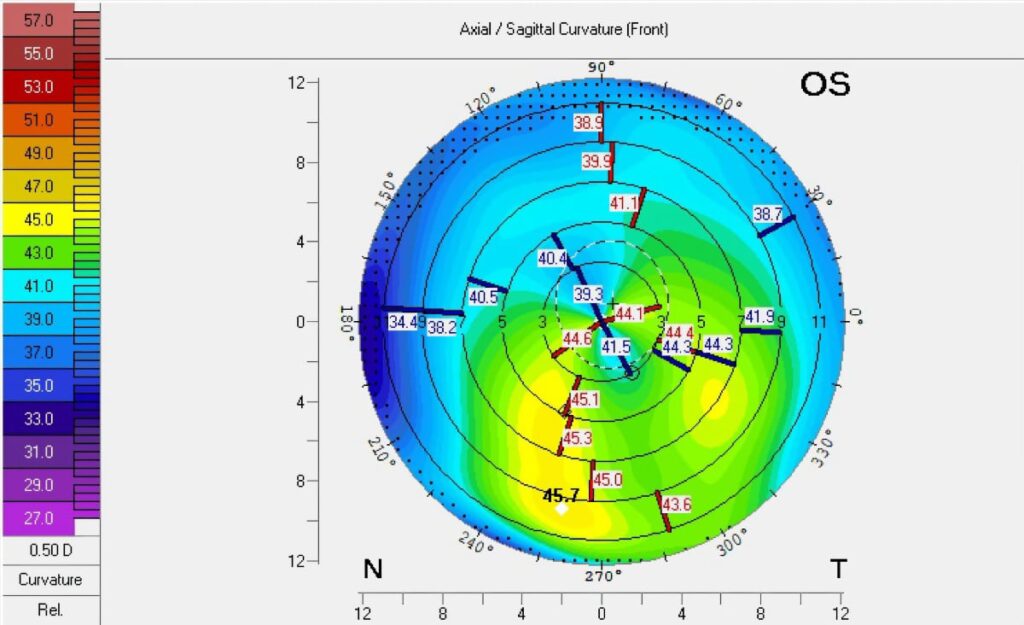
Corneal scan Southern Eye Laser NZ
An example of corneal scan data used to inform treatment.

Treating corneal conditions

Previously, people living with corneal conditions had limited treatment options: rigid contact lenses to mask the irregular shape, or in severe cases, a corneal transplant. But now TCAT (Topography-Guided Custom Ablation Treatment), combined with corneal cross-linking offers a less invasive and more modern alternative, one that can both smooth and strengthen the cornea.

About TCAT

Topography-Guided Custom Ablation Treatment (TCAT) is an advanced laser treatment that reshapes the cornea based on its exact and unique shape. Using a detailed topography map, the laser gently removes tiny amounts of tissue to smooth the surface, helping light focus more evenly.

Corneal scan for therapeutic treatment SES NZ
The aim of TCAT is to even the cornea’s surface.

When treating keratoconus or pellucid degeneration, the goal isn’t to “fix” everything with one laser session. The aim is to even the surface, reduce distortions, and improve visual quality, all while removing as little tissue as possible. The result can be clearer, sharper vision and, in many cases, more comfort when wearing contact lenses.

About corneal crosslinking

Corneal crosslinking (CXL) is designed to stop the disease from progressing. During this procedure, vitamin B2 (riboflavin) drops are applied to the cornea and activated with a special UV light. This strengthens the collagen fibres in the cornea, making it more rigid and resistant to further deformation.

How TCAT and crosslinking work together

Performed together, TCAT and crosslinking do something remarkable for corneal health:

  • TCAT improves the shape of the cornea, making vision clearer
  • Crosslinking locks that new shape in place, keeping the cornea stable for the long term
  • This combination has been shown in studies around the world to improve both vision and stability in patients with irregular corneas
  • For many people, it helps delay or even avoid the need for a corneal transplant
  • Stops the progression of keratoconus or pellucid degeneration
  • Improves the overall quality of vision
  • Makes contact lenses more comfortable or sometimes unnecessary
  • Safe, minimally invasive, and performed as an outpatient procedure
  • Provides long-term corneal stability

Patients with mild to moderate keratoconus or pellucid marginal degeneration, who have sufficient corneal thickness for safe laser treatment, are generally suitable candidates. A thorough assessment by your surgeon, including corneal scans and thickness measurements, is crucial before planning a procedure.

Meet our surgeons

TCAT and Crosslinking procedures are performed by two of New Zealand’s leading corneal surgeons, who work alongside an experienced clinical support team.

Dr Liz Conner

Dr Elizabeth Conner
MBChB, BMedSci, FRANZCO

Dr Conner took part in the first corneal cross-linking procedures at Christchurch Hospital back in 2013. The procedure has since become a standard of care in keratoconus, an area of research interest for her. An experienced cornea, cataract and refractive surgeon, Dr Conner also specialises in a comprehensive range of laser correction procedures.
Dr John Rawstron

Dr John Rawstron
MB ChB, MPH, GDipM (Refract Surg), FRANZCO

Dr Rawstron, one of New Zealand’s leading cornea surgeons, brings international surgical qualifications and fellowship training to the SES team. In addition to LASIK, SMILE pro, PRK and lens surgery procedures, he specialises in corneal transplants and cataract surgery as part of Southern Eye Specialist’s broader ophthalmology services.

Be in to win a
whole-new-you